A plan for the page
We built inplan for people planning software with a coding agent, but the shape of the problem isn't specific to code. Anywhere you commit a lot of work on the back of a few early decisions — a chapter, an investigation, a branching storyline — the same thing helps: a shared document where your AI collaborator drafts, raises its open questions as threads you can work in parallel, and you make the calls in place before any of it hardens. Here are three makers who don't write a line of code.
The novelistKeeping a story consistent with itself
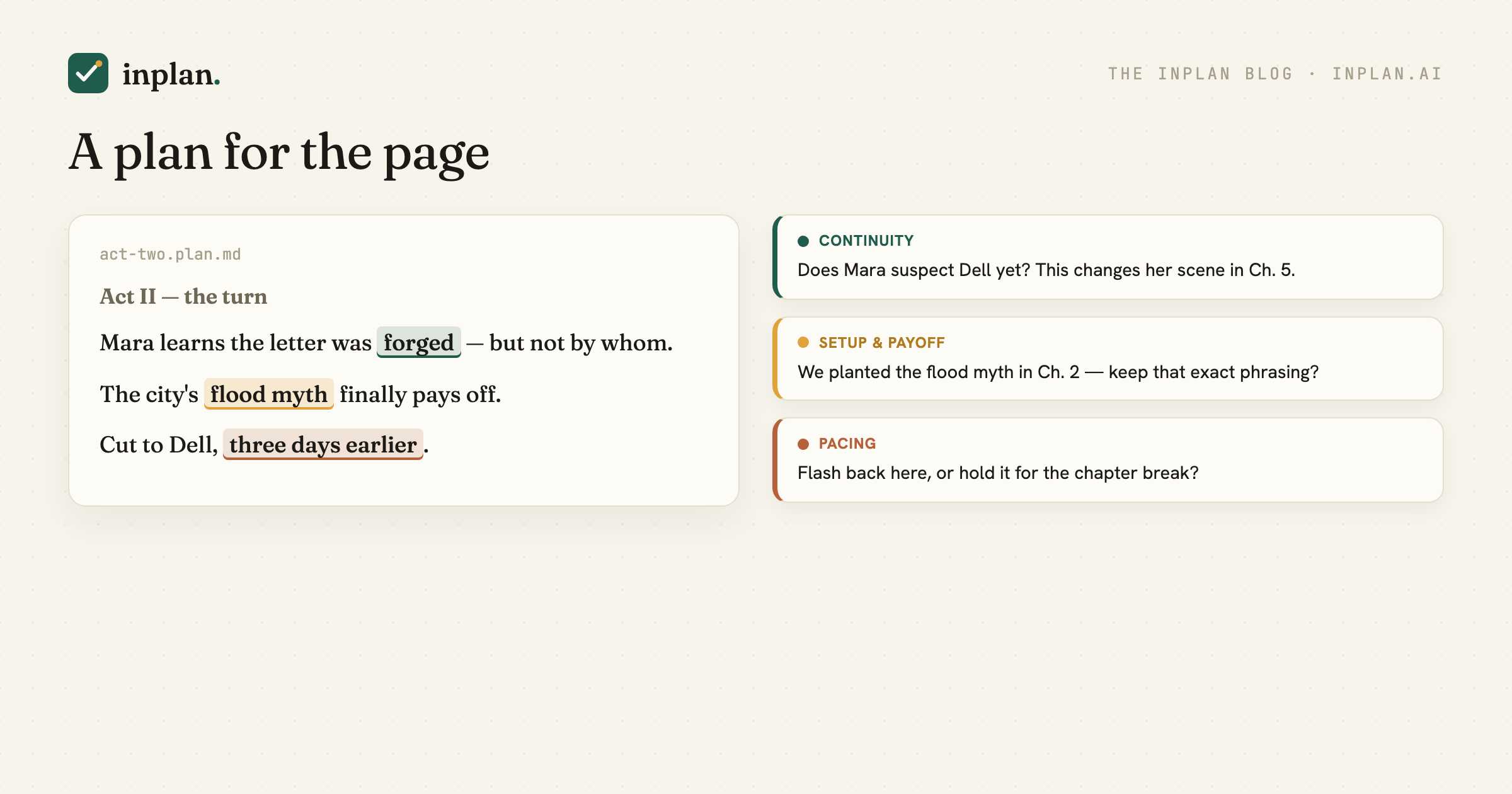
A novelist is three chapters into a draft when the plot starts fighting back. They keep the book's plan open beside the manuscript — an outline and a character bible. Their AI collaborator drafts the next act and, rather than just handing over prose, marks the places it isn't sure: does Mara know the letter is forged before the dinner scene, or after? The antagonist's motive — do we state it, or let the reader infer it? The timeline as written has her in two cities on the same day.
The author answers each question on the line it's about, and the ones that need more get another pass — the continuity thread stays open across a couple of rounds until the whole sequence lines up. Months later, when chapter nine quietly contradicts chapter three, it's the plan that catches it, because every decision is written down where the next scene can see it.
The reporterKnowing what's solid before it runs
An investigative reporter is assembling a piece with a dozen moving claims. The AI drafts a structure and flags the calls that make or break the journalism, as inline threads: what's the lede — the number, or the person it happened to? This claim rests on a single source; does it need a second before it runs? Is that quote on the record? What's the strongest counter-argument, and where in the piece does it go?
The reporter answers in place, and deliberately keeps the fact-check threads open — not resolved — until each one is actually confirmed. The document turns into the audit trail: at a glance, what's verified, what's still single-sourced, what legal hasn't cleared. Nothing runs on a decision nobody remembers making.
The narrative designerMaking the branches hold together
A game's narrative designer is building a branching quest, and branches are where stories go to rot: a choice in hour two quietly closes off an ending in hour forty, and a single line of dialogue contradicts lore three writers established last year. So the whole quest lives in one plan. The AI drafts a branch and raises the questions that only bite much later — does taking the bribe lock the player out of the paladin ending? Is this incantation consistent with the magic system in the codex? What world state does this branch assume is already true?
Several of those run at once, each its own thread, resolved over a few rounds, and the plan holds the entire tree alongside the lore decisions behind it. The next writer builds on canon that's written down, instead of guessing at it and hoping.
Whether it ends in a commit or a chapter, the work is the same: decide the ambiguous things before they're expensive to change.
Different crafts, same shape
None of these makers is writing code, and all of them are doing the thing planning is actually for — settling the calls that get costly once you've built on top of them, before the chapter is drafted, the story is filed, the branch is shipped. And all of them are now working alongside an AI that will, left to itself, quietly decide those things for them. A shared document — where the AI pins each question to the exact spot it's about, you mark up the whole thing in a single pass instead of one message at a time, and each thread can go a few rounds deep — keeps the reasoning in one spot instead of scattered across a dozen chat windows — and keeps it there. A chat scrolls away; the comments stay in the document, so the decisions are still legible long after the conversation that made them. And because raising a question is that quick and that precise, the hard calls get thought through before the work is committed, not after. A plan is a plan, wherever it ends up.
Whatever you're planning
inplan is a shared planning document for you and your AI collaborator — it drafts, raises the open questions inline, and you decide, together, before you commit to the page. Free and open source.
inplan on GitHub inplan.ai